How ABDM Is Reshaping India’s HealthTech Market—and Creating New Opportunities for App Developers
India’s healthcare technology market is entering a new phase.
For years, healthcare software in India has largely been built around individual hospitals, clinics and healthcare organizations. Many applications have been locally installed, LAN-based systems with proprietary databases and limited interoperability with other applications.
That model is beginning to change.
The Ayushman Bharat Digital Mission (ABDM) is creating the foundations for a more connected and interoperable healthcare ecosystem. While ABDM is often discussed in terms of digital health IDs, health information exchange and interoperability, its implications extend much further.
ABDM is changing the technology architecture, economics and competitive landscape of healthcare software.
For healthcare organizations, this means adapting to a more connected digital environment.
For software vendors, it creates new compliance and technology challenges.
But for healthtech developers and startups, it creates something even more interesting:
A new market for specialized, interoperable healthcare applications.
The opportunity is not simply to build another Hospital Information System (HIS).
It is to build the next generation of healthcare applications that can plug into an interoperable ecosystem—and to do so faster and at a lower cost than was previously possible.
From Standalone Healthcare Software to an Interoperable Ecosystem
Historically, healthcare software has often been developed as a standalone product.
A typical application might manage:
- Patients
- Appointments
- Encounters
- Clinical records
- Billing
- Laboratory results
- Pharmacy
- Reports
The application would have its own database, user management, APIs and workflows.
If another system needed information from it, a custom integration would usually be developed.
This has resulted in a highly fragmented healthcare technology landscape.
Different systems may represent the same patient, diagnosis, medication or clinical observation in completely different ways.
ABDM is helping move the industry towards a fundamentally different model.
Healthcare applications are increasingly expected to participate in a connected ecosystem where information can be exchanged using standardized mechanisms.
This changes the role of software.
An application no longer needs to be an isolated system that owns all the data it generates.
Instead, it can become one component in a larger healthcare ecosystem.
That shift has major implications for developers.
ABDM Is Changing the Economics of Healthcare IT
One of the less-discussed consequences of ABDM is that it changes the economics of building healthcare software.
In the past, a small healthcare IT company could build a product for a particular region or group of hospitals and differentiate itself through local relationships, customization and on-site support.
A local vendor could install software on a hospital server, connect computers through the hospital’s LAN and provide periodic updates.
That model could work reasonably well when interoperability was optional.
The environment is different when applications need to interact with a broader digital health ecosystem.
Healthcare software vendors increasingly need to consider:
- Healthcare interoperability
- Standardized APIs
- FHIR
- Digital health identities
- Consent-aware information exchange
- Security and auditability
- Cloud infrastructure
- Multi-tenancy
- ABDM ecosystem integration
- Certification and compliance
- Continuous updates as standards evolve
For a large technology company, these may be manageable investments.
For a small local vendor serving a limited number of healthcare organizations, however, the economics can become challenging.
The issue is not necessarily that local healthcare IT vendors will disappear.
Rather, the cost of remaining competitive is increasing.
A vendor can no longer compete solely on local installation, customization and support.
The ability to provide a secure, connected and interoperable healthcare application is becoming an increasingly important part of the value proposition.
This could accelerate consolidation in parts of the healthcare IT market while simultaneously creating opportunities for a new generation of cloud-native healthtech companies.
The Shift from LAN-Based Software to Cloud-Native Healthcare
Another major transformation is the move from locally installed software towards cloud-hosted and always-connected applications.
A traditional healthcare deployment often looks like:
Hospital → Local Server → LAN → Desktop Applications
This architecture has several limitations.
Every installation may require separate configuration, upgrades, backups, monitoring and support.
Integrations also need to be managed independently at each customer location.
A cloud-native model looks very different:
Healthcare Organization → Secure Internet → Cloud Application → APIs → Healthcare Ecosystem
The application can be centrally maintained and continuously updated.
New features can be deployed without physically visiting every hospital.
Infrastructure can be standardized.
APIs can be exposed consistently.
And the same platform can potentially serve healthcare organizations across multiple locations and geographies.
This is particularly important for healthtech startups.
Healthcare software is becoming a SaaS opportunity
Cloud infrastructure enables a fundamental change in the economics of software distribution.
Instead of:
Build → Install → Customize → Maintain separately for every customer
the model becomes:
Build → Deploy centrally → Continuously improve → Scale
This dramatically reduces the marginal cost of deploying software to additional customers.
For developers, that means a healthcare product can potentially move beyond the geographical limitations that traditionally constrained local health-IT businesses.
The market becomes national—and potentially global.
Standards-Based Healthcare Data Is Becoming Essential
The transition to interoperable healthcare also changes how developers should think about data.
For decades, the database has been at the center of healthcare software.
Every vendor creates its own schema.
One application might have a patient_master table.
Another might have patient_registration.
One might store an encounter as a visit.
Another might call it an episode.
One system may represent a blood pressure reading in one format while another represents it differently.
As long as applications operate independently, this may not be a major problem.
But it becomes a major problem when systems need to exchange information.
This is where healthcare standards such as HL7 FHIR and openEHR become increasingly important.
FHIR provides standardized representations and APIs for exchanging healthcare information.
openEHR provides a structured approach to persistent clinical information and clinical modeling.
Together, standards-based approaches allow developers to move away from the idea that every application must create and maintain its own isolated healthcare data universe.
The underlying principle becomes:
Healthcare data should be structured for interoperability, not just for one application’s internal requirements.
This is likely to become increasingly important as ABDM adoption and digital health interoperability mature.
A New Opportunity: Build Specialized Healthcare Applications
This transformation creates an opportunity that could be much larger than the traditional healthcare software market.
Healthcare does not necessarily need every vendor to build another complete HIS.
Instead, developers can focus on individual problems.
Consider an ICU management company.
Its expertise might be intensive care workflows, clinical monitoring and decision support.
Why should that company have to build an entire hospital information system?
Similarly, a company specializing in nursing workflows should not need to build its own complete patient information infrastructure.
A company building a healthcare claims platform should not have to recreate the entire clinical data ecosystem.
Interoperability makes a different model possible.
Specialized clinical applications
There are opportunities across almost every clinical domain:
- ICU management
- Nursing
- Emergency care
- Operating theatre management
- Diet and nutrition
- Oncology
- Cardiology
- Diabetes management
- Physiotherapy
- Chronic disease management
- Clinical decision support
- Remote patient monitoring
Hospital operations
The opportunities extend beyond clinical applications:
- Bed management
- Appointment systems
- Queue management
- Referral management
- Inventory and supply-chain management
- Workforce management
- Infection control
- Hospital analytics
Revenue cycle and insurance
Digital healthcare also creates opportunities in financial and administrative workflows:
- Claims management
- Pre-authorisation
- Claims documentation
- Insurance reconciliation
- Revenue-cycle management
- Healthcare financial analytics
- NHCX-related applications
Patient-facing applications
Developers can build specialized applications for:
- Patient engagement
- Personal health management
- Medication adherence
- Chronic-care management
- Remote monitoring
- Preventive health
- Patient portals
Data and AI
Perhaps the most exciting opportunities will emerge around standardized healthcare data:
- Clinical analytics
- Population health
- Clinical decision support
- Risk stratification
- Healthcare AI
- Research platforms
- Predictive analytics
The common factor is interoperability.
These applications become significantly more valuable when they can participate in the broader healthcare ecosystem rather than creating another isolated data silo.
The New HealthTech Developer Does Not Need to Build Everything
This leads to an important question.
If you are a startup building an ICU application, should your engineering team spend its first year building:
- Authentication
- Organization management
- Patient management
- FHIR infrastructure
- Clinical data storage
- APIs
- Identity management
- ABDM integration
- Terminology services
- Audit infrastructure
- Multi-tenancy
- Security
- Cloud infrastructure
- Monitoring
- Backup and recovery
Or should your team spend that year building the best ICU application possible?
The answer has important consequences.
Infrastructure is necessary, but infrastructure is rarely the primary differentiator of a specialized healthtech company.
The differentiation may instead come from:
- Clinical workflow expertise
- User experience
- Domain-specific algorithms
- Automation
- AI
- Integration with medical devices
- Analytics
- Operational efficiency
- Patient outcomes
Every month spent rebuilding generic infrastructure is a month not spent improving those capabilities.
This is why healthcare infrastructure platforms can play an important role in the emerging healthtech ecosystem.
EHR.Network: Infrastructure for the Next Generation of HealthTech
EHR.Network is built around a simple idea:
Healthtech developers should be able to focus on building healthcare applications rather than rebuilding the underlying healthcare infrastructure.
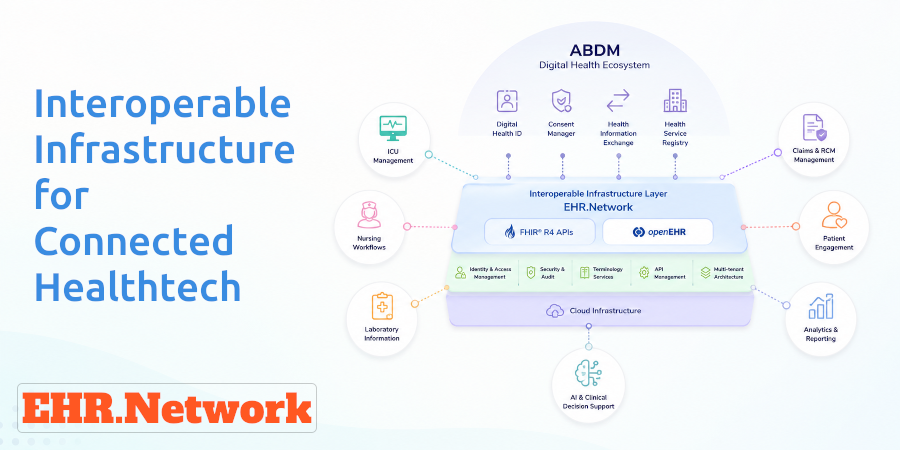
EHR.Network provides a healthcare-focused infrastructure layer incorporating technologies and capabilities such as:
- FHIR R4
- openEHR
- ABDM connectivity
- Multi-tenant healthcare architecture
- Identity and access management
- API management
- Security
- Audit
- Standards-based healthcare data
- Cloud-ready infrastructure
This allows developers to build specialized applications on top of a healthcare technology foundation instead of implementing every foundational capability themselves.
The architecture can be thought of as:
Specialized HealthTech Application
↓
EHR.Network
- FHIR
- openEHR
- ABDM
- Identity
- APIs
- Security
- Multi-tenancy
↓
Connected Healthcare Ecosystem
The application developer remains focused on the business and clinical problem.
The infrastructure provides the foundation required to operate within the digital health ecosystem.
Faster Time to Market Is Becoming a Competitive Advantage
For a healthtech startup, technology development is only one part of the challenge.
The company also needs to understand customers, validate its product, run pilots, demonstrate value and acquire paying users.
Speed therefore matters.
Imagine two teams building a new clinical application.
Team A: Build the infrastructure themselves
The team spends significant engineering effort building its database, APIs, authentication, interoperability layer, ABDM integrations, security architecture and cloud infrastructure.
Only after these components are ready can the team focus fully on its specialized application.
Team B: Use healthcare infrastructure
The team starts with a healthcare infrastructure layer and focuses its engineering effort on the clinical application.
It can spend more time on workflows, user experience, automation and customer requirements.
The second team may be able to reach pilot customers faster and learn from real-world usage earlier.
That feedback loop is extremely valuable.
Healthcare products rarely succeed because their infrastructure is technically impressive.
They succeed because they solve real problems.
Getting a product into the hands of healthcare professionals sooner can therefore be a significant competitive advantage.
From Monolithic HIS to Composable Healthcare
The long-term impact could be even more significant.
The future of healthcare software may not be dominated exclusively by large, monolithic systems that attempt to provide every possible function.
Instead, healthcare organizations could increasingly adopt a composable architecture.
For example:
Core Hospital System
├── Nursing Application
├── ICU Application
├── Diet & Nutrition Application
├── Laboratory Application
├── Pharmacy Application
├── Claims & RCM Application
├── Patient Engagement Application
├── Analytics Platform
└── AI Decision-Support Application
Each application can focus on a specific problem.
Interoperability allows those applications to work together.
This creates a new ecosystem in which a developer does not have to compete with an established HIS vendor across every possible feature.
A startup can become the best application in one specific domain.
That is a fundamentally different competitive landscape.
What HealthTech Developers Should Do Now
For developers considering building healthcare products in India, several architectural decisions are becoming increasingly important.
1. Make interoperability a core design principle
Do not treat interoperability as an integration project that can be added after the application is complete.
Design your application to work with healthcare standards from the beginning.
2. Think cloud-first
Cloud-native architecture makes it easier to deploy, maintain and scale applications across multiple healthcare organizations.
3. Avoid creating another healthcare data silo
If your application creates clinical information, consider how that information can be represented using recognized healthcare standards.
4. Focus on your domain advantage
Your competitive advantage should be the healthcare problem you solve—not the amount of infrastructure you have built.
5. Use infrastructure strategically
Building everything internally can provide control, but it also increases development time, operational complexity and long-term maintenance costs.
Using specialized healthcare infrastructure can allow smaller teams to move faster and focus their resources where they create the most value.
ABDM Could Create a Platform Economy for Healthcare
The most important consequence of ABDM may ultimately be the creation of an ecosystem in which healthcare applications can be developed, deployed and connected much more easily.
Instead of a market dominated by a relatively small number of vendors building large healthcare systems, India could see the emergence of hundreds or thousands of specialized healthtech products.
One company could build an exceptional ICU platform.
Another could transform nursing workflows.
Another could automate healthcare claims.
Another could develop an AI-powered clinical decision-support system.
Another could build a patient engagement platform.
Another could create new analytics and population-health capabilities.
If these applications are interoperable, they can become components of a much larger digital healthcare ecosystem.
This is where ABDM’s impact extends beyond interoperability.
It can lower the barriers to building connected healthcare applications.
And lower barriers to entry can create entirely new markets.
The Opportunity for Developers Is Bigger Than ABDM Integration
It is easy to think about ABDM as a compliance requirement.
But developers should also see it as a market opportunity.
The emergence of interoperable healthcare infrastructure means that specialized healthtech companies can potentially build products that were previously difficult or expensive to deploy at scale.
The opportunity is to move from:
“How do I build another healthcare system?”
to:
“What healthcare problem can I solve exceptionally well?”
That is a much more interesting question.
It opens the door to innovation across clinical care, hospital operations, insurance, patient engagement, analytics and AI.
Build the Application. Don’t Rebuild the Healthcare Infrastructure.
The Indian healthtech market is changing.
ABDM is helping establish the foundations for a more connected and interoperable healthcare ecosystem.
Cloud adoption is changing how healthcare software is deployed.
FHIR and openEHR are changing how healthcare data can be represented and exchanged.
And together, these trends are creating an opportunity for a new generation of specialized healthcare applications.
For developers, the competitive advantage may no longer come from building the largest software platform or maintaining the most complex infrastructure.
It may come from solving one healthcare problem better than anyone else—and getting that solution to market quickly.
That requires the right infrastructure.
EHR.Network is designed to provide that foundation: a healthcare-focused infrastructure platform that brings together FHIR, openEHR, ABDM connectivity, identity, APIs, security and multi-tenant capabilities.
The goal is simple:
Let developers focus on building the healthcare application.
Let the infrastructure handle the complexity underneath.
Because the next big healthtech opportunity in India may not be another monolithic hospital information system.
It may be the hundreds of specialized applications that connect together to create a truly interoperable healthcare ecosystem.
And that ecosystem is only beginning to emerge.
📞Start here to make your next healthtech idea a reality
Whether you’re a startup or an established health IT vendor, EHR.Network is your enabler to become successful in the market
🔗 Learn more about EHR.Network
📝 Contact us to learn how we can help you faster your app development
📅 Book a call to find out what it does

0 Comments