🏥 Enabling DPDP Compliance in Healthtech with EHR.Network
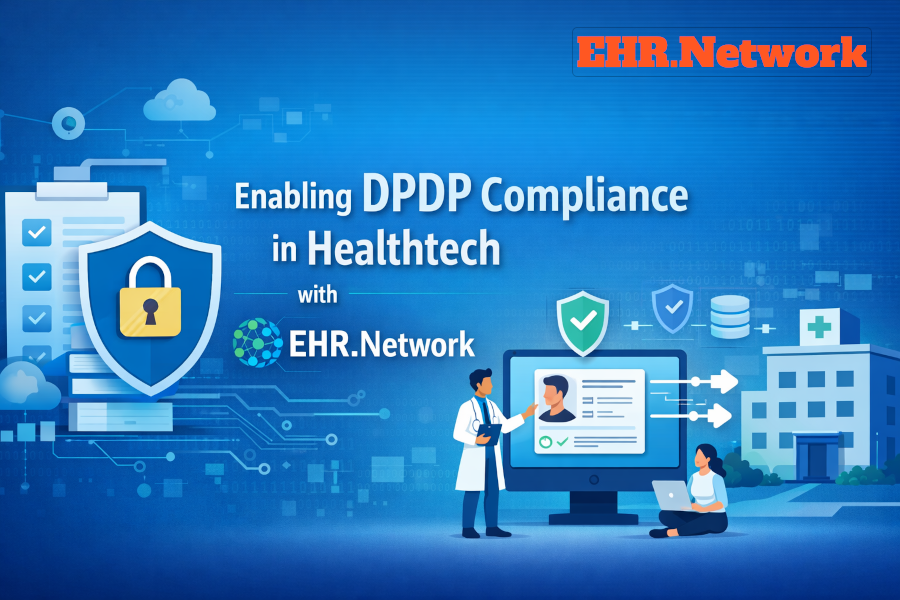
India’s healthcare ecosystem is entering a new era of data governance with the Digital Personal Data Protection (DPDP) Act, 2023. This regulation marks a decisive shift from loosely enforced privacy practices to a strict, consent-driven and accountability-focused framework.
DPDP compliance in healthtech is no longer just a legal checkbox for platforms and applications—it is an architectural requirement.
EHR.Network, built on open standards like openEHR and HL7 FHIR, enables healthcare applications to adopt a privacy-by-design approach, making DPDP compliance significantly easier to implement and scale.
📜 What is the DPDP Act? (Quick Overview)
The DPDP Act introduces a structured framework for handling personal data:
- Data Principal: The patient
- Data Fiduciary: Hospitals, clinics, health apps
- Data Processor: Technology platforms handling data
Key Principles:
- Explicit and informed patient consent
- Purpose limitation and data minimization
- Rights to access, correction, and erasure
- Mandatory breach reporting
- Strong accountability for data fiduciaries
🗓️ DPDP Timeline & Key Milestones
- August 2023 – DPDP Act passed and enacted
- 2024 – Draft rules released for consultation
- 2025–2026 (Expected) – Phased enforcement begins:
- Data Protection Board establishment
- Notification of significant data fiduciaries
- Mandatory compliance enforcement
? Implication: Healthtech platforms being built today must be DPDP-ready by design, not retrofitted later.
⚠️ What DPDP Compliance in healthtech Means for Developers
1. Consent Becomes Core Infrastructure
- Must be granular, revocable, and auditable
- Needs real-time validation before data access
2. Auditability is Mandatory
- Every data access must be logged
- Patients can request access logs
3. Data Portability is a Right
- Patients must be able to export and share records
4. Deletion vs Clinical Integrity
- Data erasure must coexist with medico-legal retention
5. Multi-Tenant Security is Critical
- No data leakage across hospitals or organizations
🚀 How EHR.Network Enables DPDP Compliance in Healthtech
EHR.Network’s architecture directly maps to DPDP requirements.
🔐 1. Role-Based Access Control (RBAC)
- Fine-grained roles (Doctor, Nurse, Admin, Auditor)
- Access limited to purpose-specific data
✅ Ensures least privilege and purpose limitation
📊 2. Immutable Audit Logs
- Tracks every read, write, and update
- Exportable for audits and patient requests
✅ Enables full transparency and accountability
🧬 3. Data Integrity & Versioning (openEHR)
- No destructive updates
- Full history of clinical changes maintained
✅ Supports right to correction + clinical safety
🔗 4. Interoperability & Data Portability
- FHIR APIs for structured data exchange
- openEHR for standardized clinical modeling
✅ Enables machine-readable data portability
🔒 5. Built-in Security Safeguards
- OAuth2 / OpenID Connect authentication
- Encryption in transit
- Secure API gateway layer
✅ Meets “reasonable security safeguards” mandate
🏢 6. Multi-Tenant Isolation
- Strict separation between organizations
- No cross-tenant data visibility
✅ Ensures data segregation compliance
✅ 7. Granular Consent Management
- FHIR-based Consent resources
- Real-time consent validation
- Revocation-aware access control
✅ Enables true consent-driven data access
👨👩👧 8. Nomination & Delegated Access
- Caregiver and nominee access via RelatedPerson
- Supports incapacity and posthumous access scenarios
🧒 9. Child Data Protection
- Parent-child linkage
- Mandatory parental consent validation
✅ Ensures compliance for minors (<18 years)
👤 10. Patient Self-Service Portal
- Consent dashboard
- Download medical records
- Request correction or erasure
✅ Empowers data principal rights
⚙️ Extending EHR.Network for Full DPDP Compliance in Healthtech
DPDP also requires operational workflows beyond core tech. Below are a few extensions under consideration in the context of DPDP act.
🗂️ 1. Data Retention & Purging
- Automated cleanup via API-driven scripts
- Configurable retention policies
? 2. Breach Notification (72-Hour Rule)
- API gateway logging (APISIX)
- Integration with log analytics tools
- DPO dashboards for anomaly detection
🔄 3. Consent-Aware API Gateway
- All requests validated against:
- User roles
- Patient consent
- Blocks unauthorized or non-consented access
✅ Creates a zero-trust data access layer
🎯 Why This Matters
Most platforms try to “bolt on” compliance later.
EHR.Network is different:
- Compliance is built into the data architecture
- Consent is enforced at runtime
- Auditability is native, not retrofitted
🧠 Final Thoughts
The DPDP Act is more than regulation—it’s a forcing function for better system design in healthcare.
Healthtech platforms that adopt:
- Open standards
- Privacy-by-design
- Consent-first architectures
will gain a competitive edge in trust, interoperability, and scalability.
EHR.Network provides the foundation to achieve this—efficiently and at scale.
📣 Call to Action (Optional Section)
Building a DPDP-compliant healthtech platform?
Talk to us about how EHR.Network can accelerate your compliance journey.
🔗 Learn more at ehr.network
📝 Get our help
📅 Book a call to discuss more

0 Comments