How EHR.Network Enables Scalable Multi-Branch, Multi-Tenant Healthcare Platforms
Healthcare organizations today are no longer single-location entities. Hospital chains, diagnostic networks, government programs, and digital health platforms operate across multiple facilities, geographies, and teams—yet they expect their health IT systems to feel unified, secure, and easy to manage.
On top of this, modern Healthcare platforms have to support multiple such healthcare organisations, with complete data isolation between each of them.
EHR.Network is built from the ground up to support this reality – Multi-Branch, Multi-Tenant Healthcare Platforms
Our platform delivers true SaaS multi-tenancy with native multi-branch support, allowing healthcare providers and healthtech vendors to scale effortlessly—without compromising on data security, compliance, or operational control.
🚑 The Real-World Problem We Solve
Most healthcare IT platforms struggle with:
• Supporting multiple hospitals under one brand
• Isolating patient data across customers
• Managing users who work across locations
• Scaling without duplicating infrastructure
• Meeting regulatory, audit, and compliance requirements
Traditionally, platforms attempt to solve this by:
• Creating separate deployments per customer or site
• Running multiple identity systems
• Manually stitching together governance and reporting
This approach is costly, fragile, and hard to scale.
EHR.Network takes a fundamentally different—and smarter—approach.
🧩 Multi-Tenancy, Done the Right Way
In EHR.Network, multi-tenancy is a first-class architectural principle, not an afterthought.
Each tenant represents a distinct healthcare network or customer, fully isolated from others while running on shared infrastructure.
What this enables
• Lower infrastructure and operational costs
• Faster onboarding of new customers
• Centralized governance and seamless upgrades
• Consistent security and compliance controls
Unlike legacy systems, all tenants operate within a single secure identity realm, eliminating fragmentation and operational overhead.
The result:
A platform that scales cleanly from a single clinic to a nationwide healthcare ecosystem.
🏥 Organizations That Reflect Real Healthcare Structures
Healthcare organizations are hierarchical by nature—and your platform should reflect that.
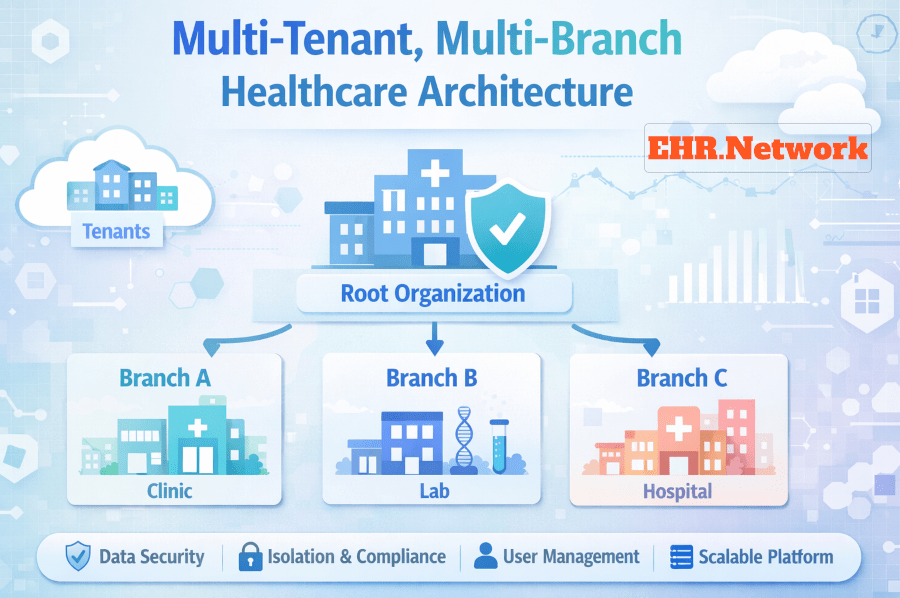
EHR.Network models real-world structures using Organizations (Orgs).
Root Organization
• Represents the primary healthcare entity
• Owns the tenant
• Controls configuration, licensing, and governance
Branch Organizations
• Represent hospitals, clinics, labs, or facilities
• Operate independently
• Remain part of the same tenant
Ideal for
• Hospital chains
• Diagnostic networks
• Franchise healthcare models
• Public–private and government healthcare programs
🌐 Built-In Multi-Branch Support
Multi-branch support in EHR.Network is native—not bolted on.
A single tenant can operate:
• One root organization
• Multiple branch organizations
• Shared or facility-specific users
• Independent workflows per branch
At the same time, platform owners can:
• Enforce licensing limits
• Control how many branches a tenant can create
• Maintain centralized oversight and reporting
This delivers the right balance between facility-level autonomy and enterprise-level governance.
🔐 Seamless User Experience Across Organizations
Healthcare professionals often work across multiple facilities. EHR.Network makes this simple, secure, and intuitive.
How it works
- Users log in once using secure OAuth / OIDC authentication
- They are assigned one active organization
- They can view and switch to other authorized organizations
- Each switch issues a fresh security token with the correct context
This ensures
• No accidental data leakage
• Clean separation of responsibilities
• A smooth, clinician-friendly user experience
🛡️ End-to-End Data Isolation You Can Trust
Security and compliance are non-negotiable in healthcare.
EHR.Network enforces isolation at every architectural layer:
• Identity layer – organization-aware security tokens
• FHIR layer – tenant-scoped API paths
• Clinical data layer (openEHR) – tenant-aware EHR metadata
Every request, every query, and every clinical record is evaluated within the correct tenant context.
This architecture supports
• Regulatory compliance
• Auditability and traceability
• Fine-grained access control
• Large-scale deployments without risk
🚀 Designed for Modern Multi-branch, Multi-Tenant Healthcare Platforms
Whether you are building:
• A Hospital Information System (HIS)
• An EMR or EHR product
• A LIMS or diagnostics platform
• A national or state health solution
EHR.Network gives you:
• A scalable SaaS foundation
• Enterprise-grade identity and access control
• Native support for complex organizational hierarchies
• A future-proof architecture aligned with FHIR and openEHR
⭐ Why This Matters
With EHR.Network, you no longer need to choose between:
• Scalability and security
• Flexibility and governance
• Speed and compliance
You get all of them—by design.
EHR.Network
Built for healthcare at scale.
Architected for multi-tenant, multi-branch healthcare platforms that demand security, compliance, and growth.
🔗 Learn more at ehr.network
📝 Get our help
📅 Book a call to discuss more


0 Comments