ABDM Integration for Diagnostic Labs in Tripura : A Complete Guide for Laboratories
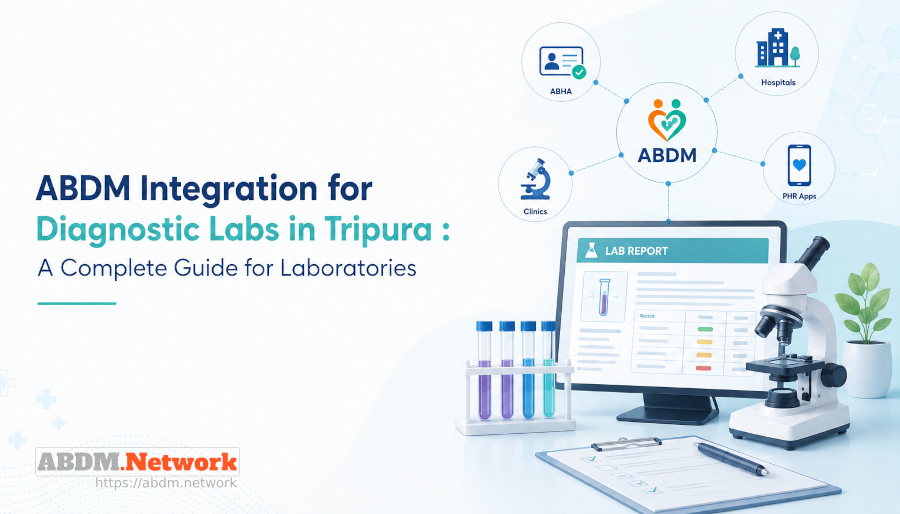
Meet the new ABDM integration requirements for diagnostic laboratories with ABDM.Network SaaS — without replacing your existing laboratory software.
Diagnostic laboratories across Tripura are approaching an important digital healthcare milestone. As part of the state’s push towards an interoperable digital health ecosystem, laboratories are expected to implement key capabilities under the Ayushman Bharat Digital Mission (ABDM).
For laboratories, this means more than simply registering patients digitally. They must be able to verify patients using their Ayushman Bharat Health Account (ABHA), link diagnostic visits to their digital health identities, make laboratory reports available for sharing through the ABDM ecosystem, and code laboratory tests using the LOINC terminology standard.
For laboratories already operating a Laboratory Information System (LIS), Laboratory Information Management System (LIMS), or other diagnostic software, the challenge is implementing these capabilities without disrupting existing workflows.
ABDM.Network SaaS helps diagnostic laboratories meet these requirements while continuing to use their existing software and infrastructure. Whether your laboratory operates entirely online or uses offline or locally installed software, ABDM.Network offers an integration approach suited to your operating environment.
What ABDM Integration for Diagnostic Labs in Tripura require?
The requirements for diagnostic laboratories in Tripura cover three essential capabilities: M1, M2 and LOINC-based test coding. M3 is an additional capability for laboratories that want to retrieve laboratory orders and other health information from hospitals and clinics with patient consent.
Let’s examine what each requirement means in practice.
1. M1: Verify and link patients using ABHA
The Ayushman Bharat Health Account (ABHA) provides individuals with a digital health identity that can be used to link their health records across participating healthcare providers.
Under the ABDM M1 milestone, diagnostic laboratories must support ABHA verification as part of patient registration and identification.
What does this mean for your laboratory?
When a patient visits your laboratory for a diagnostic test, your registration workflow should support:
- ABHA verification: Verify the patient’s ABHA using the applicable ABDM authentication workflow.
- Patient identification: Associate the verified digital health identity with the correct patient record in your laboratory system.
- Accurate record linkage: Ensure that subsequent visits and diagnostic reports are associated with the appropriate patient.
- ABHA-enabled registration: Incorporate ABHA verification into your existing patient registration process.
For example, when a patient arrives for a blood test, the laboratory can verify the patient’s ABHA and associate it with the patient’s existing laboratory record. This helps establish the digital identity required for linking diagnostic records to the patient’s health account.
ABHA integration should complement the laboratory’s existing patient identification process, helping reduce mismatches and supporting the continuity of patient records.
For further information, see the official ABDM developer documentation on M1
2. M2: Link diagnostic visits and make reports available for sharing
Verifying a patient’s ABHA is only the first step. The next requirement is to make the laboratory’s digital records available through the ABDM ecosystem.
Under M2, the laboratory acts as a Health Information Provider (HIP). It creates digital health records, associates them with identifiable care contexts, and links those contexts to the patient’s ABHA address through the prescribed ABDM workflows.
For diagnostic laboratories, the care context can represent a laboratory visit or diagnostic episode.
What must your laboratory be able to do?
- Create a care context: Associate the diagnostic visit or episode with a unique reference in the laboratory system.
- Link the care context to ABHA: Link the visit to the patient’s ABHA address using the applicable ABDM workflow.
- Publish digital diagnostic reports: Make the corresponding reports available for discovery and sharing through the ABDM ecosystem.
- Support patient access: Enable patients to access linked records through compatible Personal Health Record (PHR) applications.
- Enable authorised sharing: Support the prescribed workflows for sharing reports with clinics, hospitals and other authorised recipients.
Consider a patient who visits a laboratory in Agartala for a complete blood count.
The laboratory registers the patient, verifies their ABHA, records the visit and generates the report. Through ABDM integration, the visit can be linked to the patient’s ABHA, making the associated digital report available through the appropriate ABDM workflows.
The patient can then access the linked record through a compatible PHR application. When the patient needs to consult another doctor or visit a hospital, the report can be shared through the applicable ABDM information-exchange process, subject to the required authorisation and consent.
This can reduce dependence on paper reports, make previous diagnostic information easier to access, and help clinicians review relevant laboratory findings.
Importantly, ABDM does not require all health records to be stored in one central repository. Health information remains with the system that generated it, while ABDM facilitates interoperable discovery, consent and exchange.
For technical details, refer to the ABDM M2 integration documentation.
3. LOINC: Standardise laboratory test coding
A laboratory report contains more than numerical results. It also identifies the tests performed, the observations made and the units in which results are expressed.
Different laboratories and software systems may use different names or codes for the same test. This can make it difficult for healthcare systems to interpret diagnostic information consistently.
LOINC (Logical Observation Identifiers Names and Codes) is an internationally used terminology standard for identifying laboratory tests, clinical observations and related measurements.
Under the LOINC coding requirement communicated to laboratories in Tripura, laboratories must ensure that their diagnostic tests are represented using the appropriate LOINC codes.
For example, a laboratory might refer to a test as “Haemoglobin,” “Hb” or “Hemoglobin.” Standardised terminology helps participating systems identify the corresponding observation consistently, provided the underlying test and its characteristics match.
LOINC coding is particularly important for:
- Interoperability between different laboratory software systems.
- Consistent representation of diagnostic observations.
- Exchange of structured laboratory reports.
- Interpretation of results by receiving healthcare applications.
- Supporting clinical workflows that consume standardised diagnostic data.
For laboratories with an established test master, implementing LOINC does not necessarily mean changing the names displayed on reports or replacing the existing test catalogue.
Instead, the existing test catalogue can be mapped to appropriate LOINC codes. The laboratory can continue using familiar test names internally while exchanging standardised coded information through the applicable interfaces.
However, mapping must be performed carefully. Similar test names do not always represent equivalent observations; specimen type, method and other relevant characteristics may affect the correct code.
ABDM.Network helps laboratories address this terminology-mapping challenge via the EHR.Network Terminology look up service.
For reference, visit the ABDM documentation on LOINC.
Optional M3 integration: Receive laboratory orders from hospitals and clinics
While M1 and M2 support patient identification and the linking and sharing of diagnostic records, M3 introduces another opportunity: retrieving health information from other participating providers with the patient’s consent.
Under ABDM, M3 covers the consent-based exchange of health information when a system acts as a Health Information User (HIU).
For diagnostic laboratories, this capability can support workflows in which a laboratory receives diagnostic orders or relevant clinical information from a hospital or clinic.
For example:
- A doctor at a participating clinic orders a diagnostic test for a patient.
- The patient provides the required authorisation through the applicable ABDM workflow.
- The laboratory retrieves the permitted information through the prescribed consent-based exchange.
- The laboratory uses the received information to support its order-processing workflow.
- After performing the test, the laboratory generates the report and makes it available through its ABDM-enabled workflow.
The precise workflow depends on how the ordering clinic, laboratory and their respective software systems are integrated.
For laboratories working closely with hospitals, clinics or diagnostic networks, this can be a valuable next step towards more connected diagnostic services.
M3 is an optional extension for laboratories that want to retrieve information from other providers. It is not a substitute for the M1 and M2 capabilities required for patient verification and diagnostic-record linking.
Read more at Official M3 documentation
How can your laboratory implement ABDM without replacing its existing software?
One of the biggest concerns for diagnostic laboratories is the cost and disruption associated with changing their existing systems.
A laboratory may already have a well-established LIS, billing application, patient registration system or locally installed diagnostic software. Replacing these systems simply to support ABDM can be expensive and unnecessary.
ABDM.Network addresses this challenge with two implementation approaches.
Option 1: ABDM.Network SaaS for online laboratory systems
If your laboratory already uses an online LIS, LIMS or diagnostic management system, ABDM.Network SaaS can provide the ABDM integration capabilities needed to connect your existing workflows to the ABDM ecosystem.
The objective is to enable ABDM compliance without requiring you to replace your existing laboratory application.
Depending on your software’s capabilities and integration requirements, the implementation can support:
- ABHA verification during patient registration.
- Association of verified patient identities with laboratory records.
- Creation and linking of diagnostic care contexts.
- Publication and sharing of diagnostic reports through ABDM.
- Mapping laboratory test codes to LOINC.
- Optional M3 integration for consent-based retrieval of information from other healthcare providers.
Your laboratory continues to use its existing application for day-to-day operations, while ABDM.Network provides the integration layer needed for the relevant ABDM workflows.
This approach can be particularly suitable for laboratories whose software vendors already support APIs or other integration interfaces.
Option 2: ABDM.Network Middleware for offline and locally installed systems
Not every laboratory operates on a fully online platform.
Many diagnostic centres use locally installed software, desktop applications or systems designed around on-premises workflows. Some may have limited internet connectivity or lack the interfaces required for direct ABDM integration.
For these laboratories, ABDM.Network offers a client-hosted ABDM.Network Middleware as a cloud repository.
This approach is designed to help existing offline or locally installed laboratory systems participate in the ABDM ecosystem without requiring an immediate replacement of their core software.
The middleware provides an integration layer between the laboratory’s existing system and the ABDM-enabled services.
Depending on the source system and the agreed implementation, this architecture can support the exchange of relevant patient, visit, test and report information.
It provides a path for laboratories to retain their existing operational workflows while introducing the capabilities needed for ABDM integration.
The exact deployment, synchronisation and connectivity arrangements can be tailored to the laboratory’s environment.
Whether your laboratory uses an online LIS or locally installed diagnostic software, ABDM.Network provides an integration path suited to your existing infrastructure.
Why choose ABDM.Network for your laboratory?
Meeting ABDM requirements involves more than connecting to an API. Laboratories must bring together patient identification, diagnostic workflows, terminology mapping and the exchange of health information.
ABDM.Network is designed to help healthcare organisations address these requirements through a unified integration platform.
1. Keep your existing laboratory software
You do not necessarily need to replace your LIS, LIMS or diagnostic management application to introduce ABDM capabilities.
ABDM.Network can integrate with suitable existing systems, helping you avoid the cost and operational disruption of a complete software replacement.
2. Choose the deployment model that suits your laboratory
Every diagnostic centre has different technical requirements.
- Online laboratories: Integrate through ABDM.Network SaaS.
- Offline or locally installed systems: Use the client-hosted ABDM.Network Middleware cloud repository.
The appropriate approach depends on your current software, available interfaces, connectivity and workflow requirements.
3. Implement M1 and M2 through a unified integration approach
Rather than treating ABHA verification, care-context linking and report sharing as separate software projects, laboratories can address these capabilities through a coordinated integration strategy.
This helps simplify the implementation and maintenance of ABDM workflows.
4. Address LOINC mapping without rebuilding your test catalogue
LOINC terminology mapping is a significant consideration for diagnostic software.
ABDM.Network can help map the laboratory’s existing test catalogue to appropriate standardised codes, subject to validation of the tests and their relevant characteristics.
This allows laboratories to retain their familiar internal workflows while improving the consistency of diagnostic information exchanged with other systems.
5. Prepare for deeper integration with hospitals and clinics
Laboratories that want to go beyond the immediate requirements can explore M3 integration for consent-based retrieval of health information.
This can help lay the foundation for more connected diagnostic workflows with participating hospitals and clinics.
6. Work with a platform built for healthcare interoperability
ABDM integration requires coordination between patient identity, healthcare records, terminology and information-exchange workflows.
ABDM.Network focuses on providing the integration capabilities needed to connect healthcare applications with India’s digital health ecosystem.
For laboratories, this means being able to focus on their core operations while working towards the necessary digital interoperability capabilities.
Note: The exact scope of integration, testing, certification and production deployment will depend on the laboratory’s software, implementation model and applicable ABDM requirements.
What should diagnostic laboratories in Tripura do now?
Since the health department has presented this requirement, laboratories should begin assessing their existing systems and integration requirements without delay.
We recommend the following steps.
Step 1: Assess your existing software
Identify the application you use for patient registration, billing, test management and report generation. Determine whether it is online, locally installed or a combination of both.
Step 2: Review your patient identification workflow
Check how your laboratory identifies patients and whether your existing system can support ABHA verification and the association of verified identities with patient records.
Step 3: Assess your diagnostic-report workflow
Determine how your system records visits, generates reports and identifies the patient and diagnostic episode associated with each report.
Step 4: Review your laboratory test catalogue
Assess your existing test master and identify the work required to map your tests to appropriate LOINC codes.
Step 5: Select an appropriate integration approach
Choose an integration model that works with your current software and operating environment.
Step 6: Plan implementation and validation
Allow time for integration, testing, workflow validation and any applicable ABDM certification or production-readiness requirements. Confirm the precise compliance requirements and deadline with the relevant authorities.
Starting early can help avoid last-minute implementation challenges and give your laboratory time to validate its workflows before the deadline.
Frequently asked questions
Is ABDM integration required for diagnostic laboratories in Tripura?
Based on the feedback that we have received from the market, diagnostic labs are expected to be ABDM compliant in the coming days. Laboratories should confirm the applicable order and implementation instructions with the relevant state authorities.
Do I need to replace my existing LIS or LIMS?
Not necessarily. ABDM.Network is designed to support integration with suitable existing laboratory systems. Online systems can use the SaaS approach, while offline or locally installed systems can explore the middleware-based approach.
What is the difference between M1 and M2?
M1 covers ABHA creation and verification. M2 enables healthcare providers, including diagnostic laboratories, to link digital health records to patients’ ABHA addresses and make those records available through the ABDM ecosystem.
Why is LOINC important for diagnostic laboratories?
LOINC provides standardised identifiers for laboratory tests and clinical observations. Appropriate coding helps different healthcare applications interpret diagnostic information consistently.
Is M3 compulsory for every diagnostic laboratory?
M3 is an additional capability for retrieving health information from other participating providers through consent-based exchange. A laboratory focused on publishing its own diagnostic reports should first address the applicable M1 and M2 requirements.
Can a laboratory using offline software implement ABDM?
Yes, subject to the capabilities of the existing system and the implementation requirements. ABDM.Network’s middleware-based approach is intended to support laboratories that cannot integrate directly through an online application.
Will ABDM.Network help with LOINC mapping?
ABDM.Network can help map existing laboratory test catalogues to appropriate LOINC codes via the EHR.Network terminology lookup service. Laboratories can use this lookup for validation of the underlying tests and associating them with LOINC Codes.
Get your diagnostic laboratory ready for ABDM
The move towards interoperable digital healthcare creates an opportunity for diagnostic laboratories to improve how patients access their reports and share diagnostic information with healthcare providers.
For laboratories in Tripura, the immediate priority is to address ABHA verification, diagnostic-record linking and sharing, and standardised laboratory test coding within the required timeframe.
You do not have to begin by replacing your existing software.
ABDM.Network helps diagnostic laboratories integrate with ABDM while continuing to use their existing online or locally installed systems.
Whether you operate an independent diagnostic centre, a multi-location laboratory or a laboratory serving hospitals and clinics, our team can help you assess the appropriate integration approach.
Contact ABDM.Network to discuss your laboratory’s existing software, integration requirements and implementation plan.
🔗 Learn more about ABDM.Network

0 Comments